
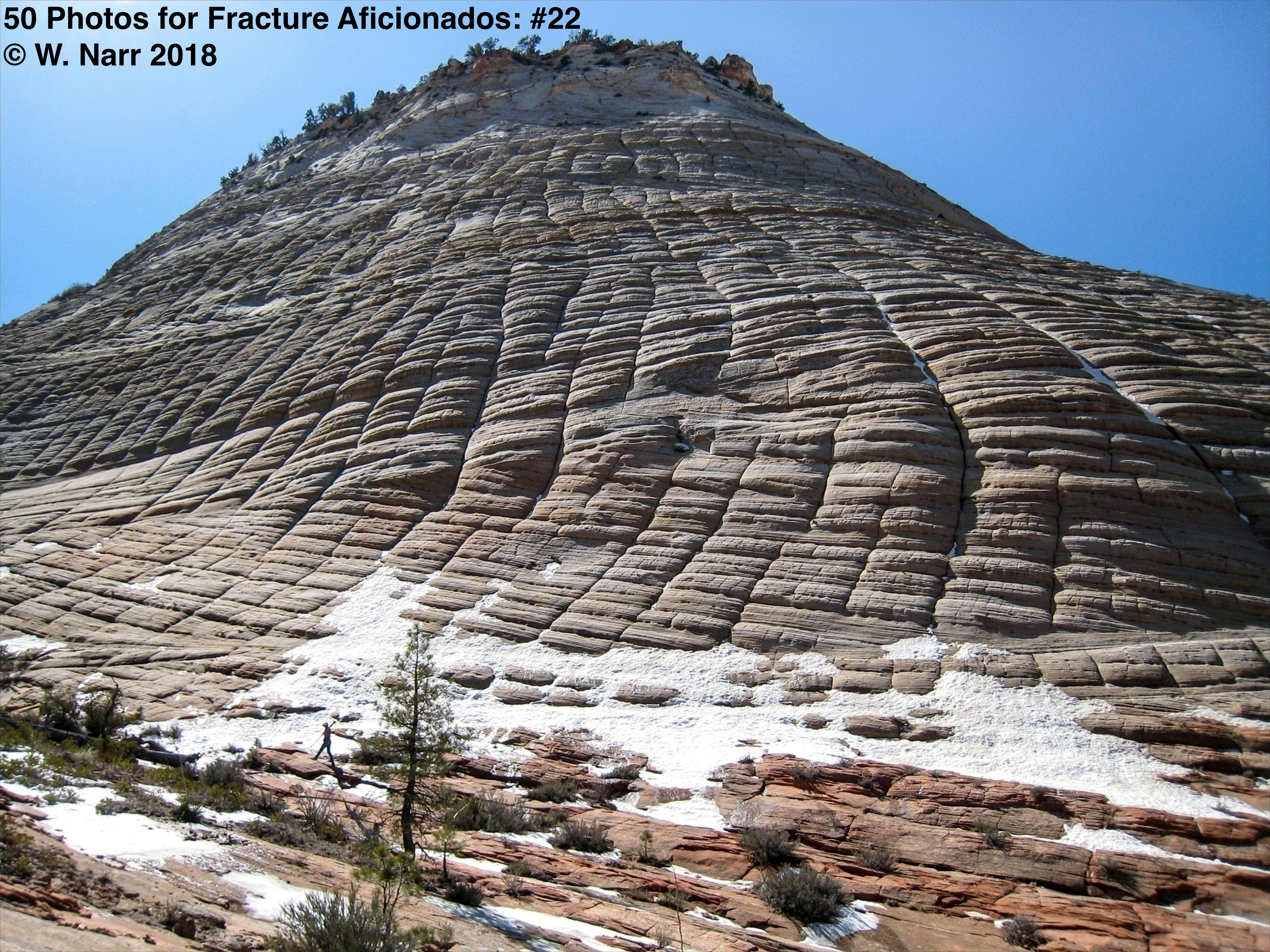
Joints Jump with Stratigraphy on Checkerboard Mesa
Changing bedding orientation is reflected in changing joint orientations
Aeolian sands of the Navajo Formation show their typical high-angle cross bedding here at Checkerboard Mesa, on the east side of Zion National Park in Utah.Starting in the lower right corner of the photo and proceeding upsection towards the center, bedding dips to the right, then left, then right, then left.
The joints, in a quest to remain normal to stratigraphy, dip steeply in directions opposite to the ping-pong of bedding.We can all agree the dip of bedding predates the fractures.The fractures propagated under the influence of the mechanical geometry of this layered system.However, if the dip of these strata was due to folding, and the fractures were bed-normal, the question of “which came first – folding or fracturing?” would surely be raised (See, for example, the first image of this series)In my experience, most geologists would argue that the fractures had been rotated along with bedding.
When considering the timing relationship of joints and folding, one will do well to bear in mind this image of Checkerboard Mesa.
Another aspect of joints here is their extraordinarily regular spacing.This is quite the opposite of the clustering seen at in Ireland’s Burren (photo #21 of this series).Mechanical layer thickness often controls joint spacing (again, see image #1, above).Does this “rule” apply here?How to define the mechanical layers at Checkerboard Mesa?
Another unresolved question about this exposure is the degree to which the joints are penetrative vs. surficial.Certainly the smaller joints that lie between the prominent joints (zoom in to see them) are surficial, and I believe many of the prominent joints are as well.If so they must have formed after erosion had exposed the present surface to, or near to, the domain of weathering.If the joints formed only when the outermost rind of rock was within the influence of weathering or other surficial processes (e.g. diurnal temperature flux) they surely are not under the influence of an active far-field stress.So why are the joints parallel?In the absence of an anisotropic stress within the horizontal plane why don’t the fractures form a random pattern like mud cracks?Are the joints controlled by a residual elastic stress component imparted in the rock when it was deeply buried and under the influence of a persistent tectonic stress field?
Mother Nature defeats us on her Checkerboard.
(Photograph courtesy of Stephan Brocoum)