
Muddying a good theory at Muddy Mountain
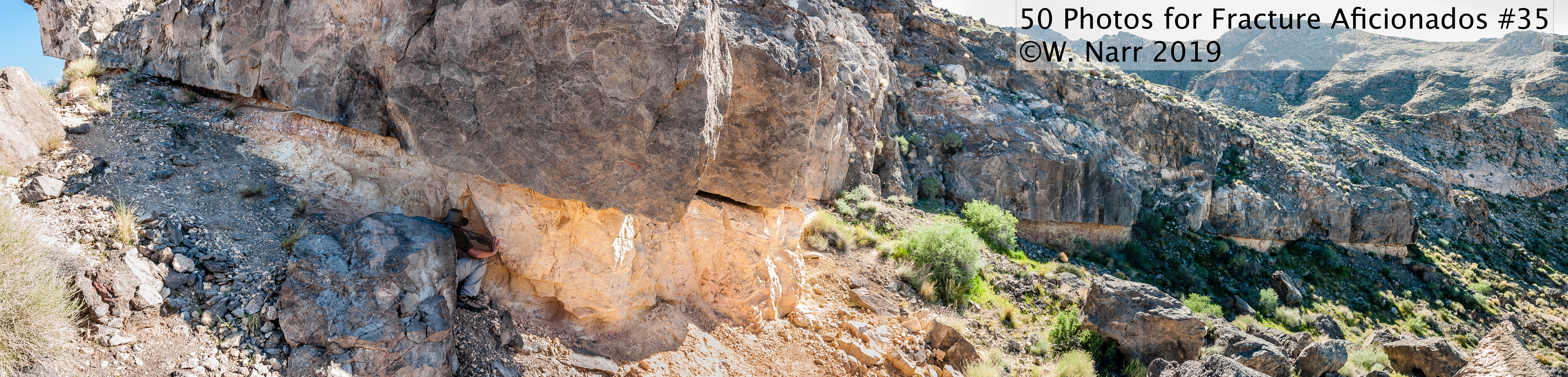
The Muddy Mountain Thrust is the largest single fracture in this photographic collection of fractures so far. This outcrop of the fault is in the Muddy Mountains of southern Nevada, in the Buffington Pockets window. Cambrian carbonates comprise the gray rock in the hanging wall (according to USGS map by Beard, 2007). Paleozoic carbonates occur in the hanging wall throughout a vast area. The pinkish-orange to red strata in the footwall are rocks of the Jurassic Aztec Formation.
The Buffington Pockets window is an area where the thrust fault has been unroofed by erosion, allowing the observer to see through to the footwall. Muddy Mountain thrust is actually a thrust system, so that total displacement is partitioned among several closely spaced and connected fault surfaces.
This fault formed during the Cretaceous Sevier Orogeny. Its N-S strike length is 210 kms, and total displacement is about 50 kms of W to E tectonic transport. Despite the enormous size and displacement of the fault, strata above and below are dipping gently, and are essentially concordant. There is, however, evidence of deformation evident within a few meters of the fault zone.
The geologist in the photo, Vincent Heesakkers, is looking at a dark gray clast embedded in the sandstone wall, visible just right of his shoulder. Also, notice the dark pebbles in the sandstone to the right of his foot (you’ll need to zoom in). These clasts originated from the rock in the hanging wall and have been incorporated into this thrust zone. If you look carefully in the hanging wall, towards the right side of the gray block above Vincent’s head, a few narrow stringers of orange-red sandstone are visible, which likely originated from within the Aztec. Many small-scale normal and thrust faults are visible in a zone a few meters thick both above and below the fault. I find it remarkable that these strata are not more-strongly deformed in a wider damage zone for a fault with 50 kms displacement!
I’ll finish with a comment that is controversial and which some will insist cannot be right. Most of us, especially my structural geology brethren, have been schooled in the concept that the only way to move a large thrust sheet is with the aid of significant pore-fluid overpressure. Recall the Hubbert and Ruby (1959) beer can experiment? Lacking such a buoyancy affect the hanging wall will deform internally, and pile up like the snow in front of a plow. But I don’t see how it would be possible to maintain overpressure in the Muddy Mountain thrust sheet.
In a key study Brock & Engelder (1977) describe the occurrence of thrusting-contemporaneous stream channels in molasse deposits exposed beneath the Muddy Mountain thrust, demonstrating that during thrusting the fault was at or very near the ground surface. It isn’t possible to develop region-wide overpressure so close to the surface of the ground. Furthermore, the Aztec Formation in the footwall has a permeability greater than 100mD measured at nearby sites. Any overpressure that developed near the thrust surface would bleed off in this high-perm strata, which was probably exposed in nearby outcrops during thrusting. Finally, the hanging wall is thick but fractured, and appears to lack any strata that would act as a pressure seal. Hence overpressure would likely bleed off through fractures in the hanging wall.
The enigma of the emplacement of large thrust faults is sustained!