
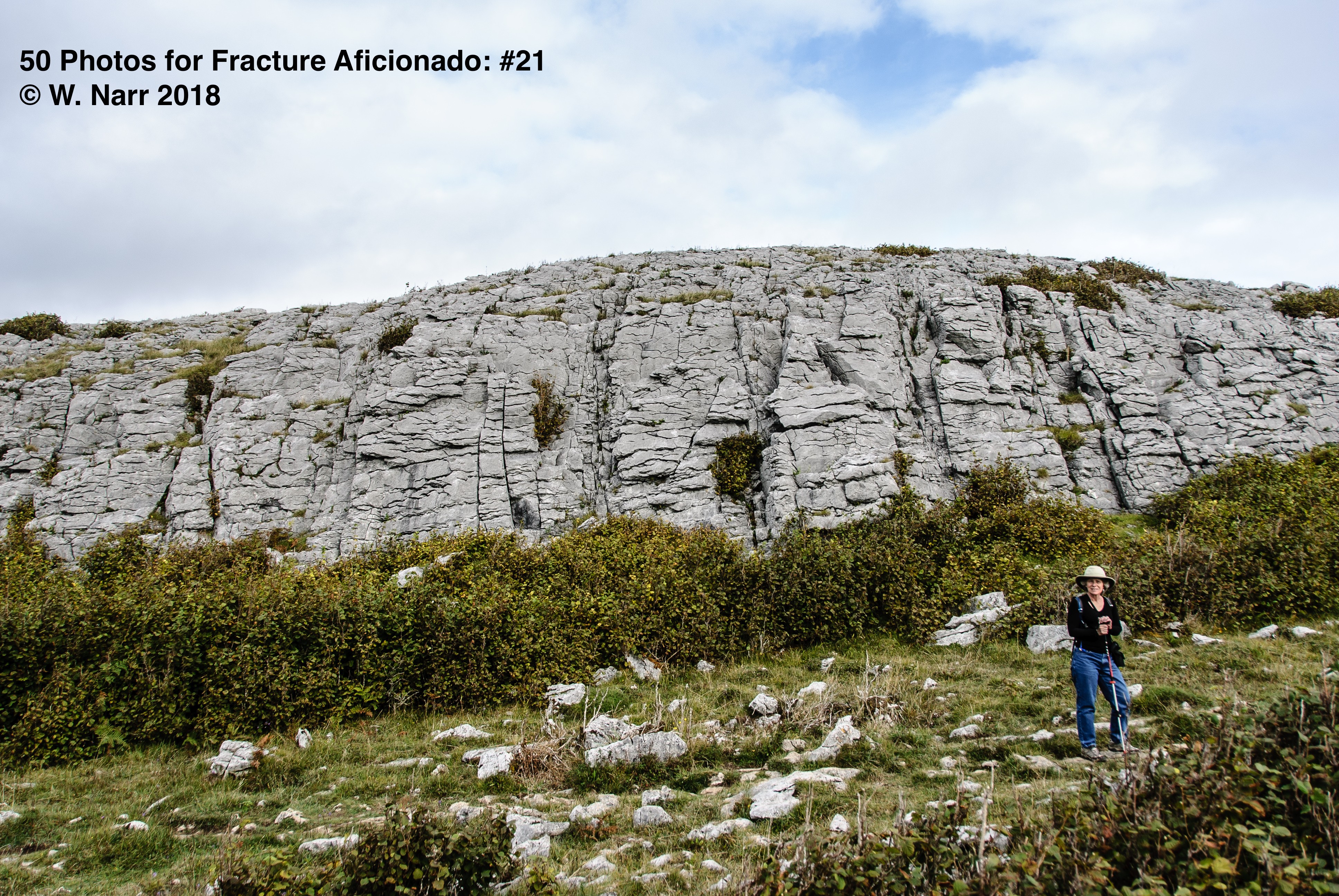
Clusters in the Burren
Why do these joints preferentially cluster at this and other nearby exposures?
These gently dipping Mississippian limestone beds in the Burren National Park of Ireland present a quandary.The joints are approximately normal to bedding.But rather than spaced individual joints that are so commonly seen, these joints occur in spaced clusters.
Why should multiple, parallel joints develop just a few centimeters apart as a cluster, which is then spaced a couple of meters from its neighboring cluster? Why have the joints formed clusters rather than separate individual fractures?
In theory, an open fracture is enveloped by a stress shadow such that the decoupling across the fracture relieves stress in its vicinity, thereby suppressing the formation of additional fractures to either side of it.It does not appear as if any such stress-shadow effect was operative here based on the clustering of individual fractures.Rather, the clusters appear to be controlled by stress-shadow-imposed spacing. The clustering behavior here is particularly puzzling because it repeats with such regularity.This leads to the expectation that a simple explanation should account for it.If such an explanation exists I’m unaware of it.
Might these be a consequence of minor faulting?If so, the faults are of microscopic offset.And if faulting is the cause, why should it produce such regularly spaced features – features that have the systematics and character of joints except for the clusters?
Consider trying to characterize the spacing of such fractures.It requires more thought than computation of a simple mean.And what might we expect of the timing and sequence of development of the fractures within such a cluster?I have more questions than answers for these fractures.